edited by
0 0 votes

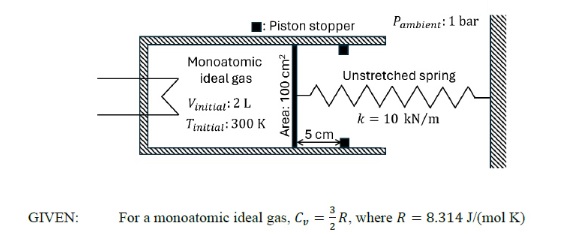
An ideal monoatomic gas is contained inside a cylinder-piston assembly connected to a Hookean spring as shown in the figure. The piston is frictionless and massless. The spring constant is $10 \mathrm{kN} / \mathrm{m}$. At the initial equilibrium state (shown in the figure), the spring is unstretched. The gas is expanded reversibly by adding $362.5 \:J$ of heat. At the final equilibrium state, the piston presses against the stoppers. Neglecting the heat loss to the surroundings, the final equilibrium temperature of the gas is $\_\_\_\_\_ \mathrm{K}$ (rounded off to the nearest integer).
1 Answer

0 0 votes
  • 1. Moles of gas (n):

    • P1​=1bar=1×10⁵Pa (Correct conversion)
    • V1​=2L=2×10⁻³m3 (Correct conversion)
    • T1​=300K
    • $R = 8.314 \, \text{J/(mol·K)}$
    • $n = \frac{P_1 V_1}{R T_1} = \frac{(1 \times 10^5 \, \text{Pa})(2 \times 10^{-3} \, \text{m}^3)}{(8.314 \, \text{J/(mol·K)})(300 \, \text{K})} \approx 0.0802 \, \text{mol}$.
  • 2. Volume change (ΔV):

    • A=100cm2=100×(10−2m)2=100×10−4m2=1.0×10⁻²m2 (Correct conversion)
    • x=5cm=0.05m (Correct conversion)
    • ΔV=A⋅x=(1.0×10⁻²m2)(0.05m)=5.0×10⁻⁴m3.
  • 3. Work against atmosphere (Watm​):

    • Pamb​=1bar=1×10⁵Pa (This assumes the ambient pressure is the same as the initial gas pressure, which is a reasonable assumption for equilibrium with an unstretched spring).
    • Watm​=Pamb​ΔV=(1×10⁵Pa)(5.0×10⁻⁴m3)=50J.
  • 4. Spring work (Wspring​):

    • k=10kN/m=10000N/m
    • Wspring​=21​kx2=21​(10000N/m)(0.05m)2=21​(10000)(0.0025)=12.5J.
  • 5. Total work (Wtotal​):

    • Wtotal​=Watm​+Wspring​=50J+12.5J=62.5J.
  • 6. Change in internal energy (ΔU):

    • ΔU=Q−Wtotal​=362.5J−62.5J=300J.
  • 7. Temperature rise (ΔT):

    • For a monatomic ideal gas, ΔU=nCv​ΔT=n(23​R)ΔT.
    • $\Delta T = \frac{\Delta U}{n (\frac{3}{2}R)} = \frac{300 \, \text{J}}{(0.0802 \, \text{mol})(\frac{3}{2} \times 8.314 \, \text{J/(mol·K)})} = \frac{300}{0.0802 \times 12.471} = \frac{300}{1.000} \approx 299.99 \, \text{K} \approx 300 \, \text{K}$.
  • 8. Final temperature (T2​):

    • T2​=T1​+ΔT=300K+300K=600K.
Answer:
Position:
Show: