A catalyst particle is modeled as a symmetrical double cone solid as shown in the figure. For each conical sub-part, the radius of the base is $r$ and the height is $h$. The sphericity of the particle is given by
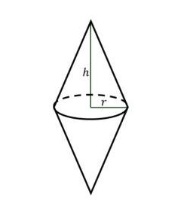
- $\frac{2\left(\frac{r^{2} h}{2}\right)^{1 / 3}}{r \sqrt{\left(r^{2}+h^{2}\right)}} $
- $\frac{\left(\frac{r^{2} h}{2}\right)^{1 / 3}}{r \sqrt{\left(r^{2}+h^{2}\right)}}$
- $\frac{2\left(\frac{r^{2} h}{2}\right)^{2 / 3}}{r \sqrt{\left(r^{2}+h^{2}\right)}}$
- $\frac{\left(\frac{r^{2} h}{2}\right)^{2 / 3}}{r \sqrt{\left(r^{2}+h^{2}\right)}}$
