• moved by
4 4 votes

Six persons $\text{P, Q, R, S, T and U}$ are sitting around a circular table facing the center not necessarily in the same order. Consider the following statements:

  • $\text{P}$ sits next to $\text{S}$ and $\text{T}$.
  • $\text{Q}$ sits diametrically opposite to $\text{P}$.
  • The shortest distance between $\text{S}$ and $\text{R}$ is equal to the shortest distance between $\text{T}$ and $\text{U}$.

Based on the above statements, $\text{Q}$ is a neighbor of

  1. $\text{U}$ and $\text{S}$
  2. $\text{R}$ and $\text{T}$
  3. $\text{R}$ and $\text{U}$
  4. $\text{P}$ and $\text{S}$

3 Answers

3 3 votes

Given that, six persons $\text{P, Q, R, S, T}$ and $\text{U}$ are sitting around a circular table facing the center not necessarily in the same order.

  • $\text{P}$ sits next to $\text{S}$ and $\text{T}$.
  • $\text{Q}$ sits diametrically opposite to $\text{P}$.
  • The shortest distance between $\text{S}$ and $\text{R}$ is equal to the shortest distance between $\text{T}$ and $\text{U}$.

Based on the above statements, we can draw the sitting arrangements.
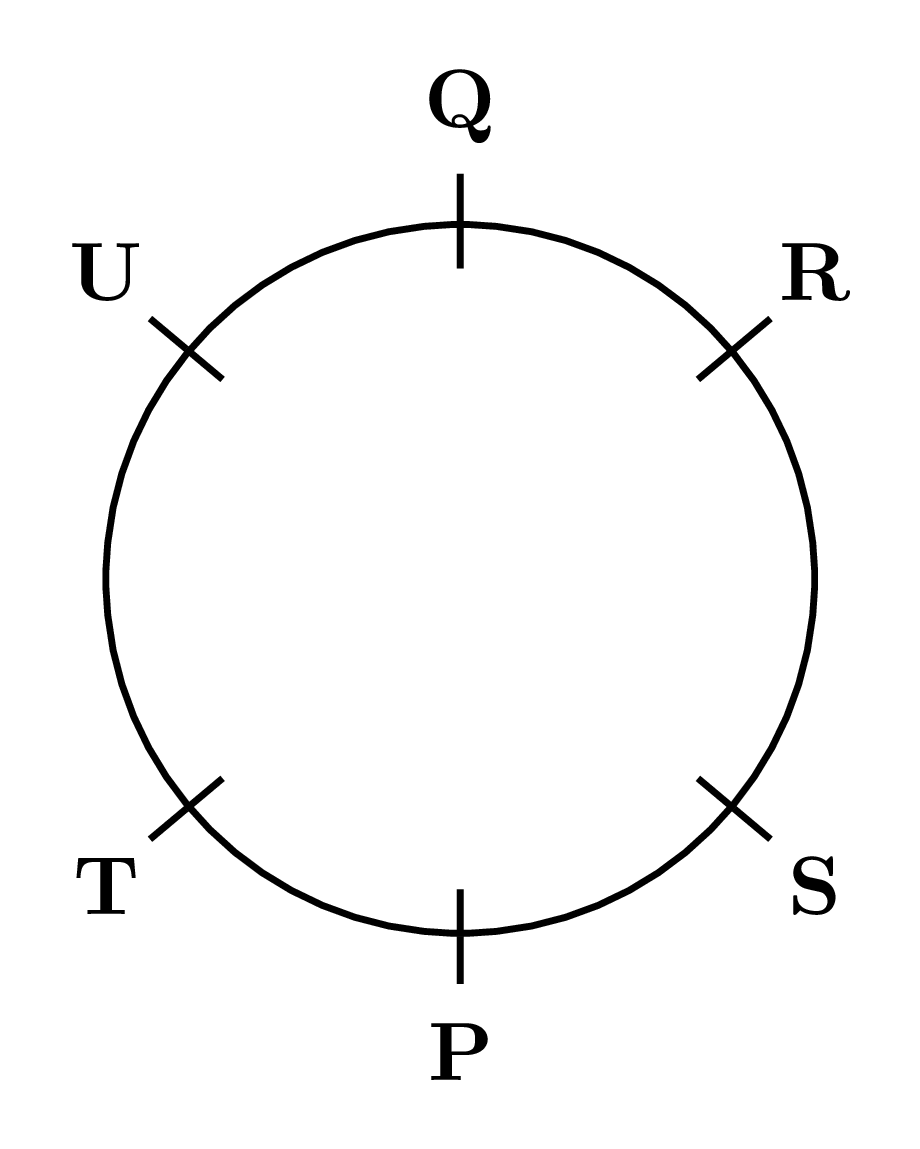
We can also draw the diagram, by changing the position of $\text{S, T}$ and $\text{R, U},$ because there is no restriction for these persons.
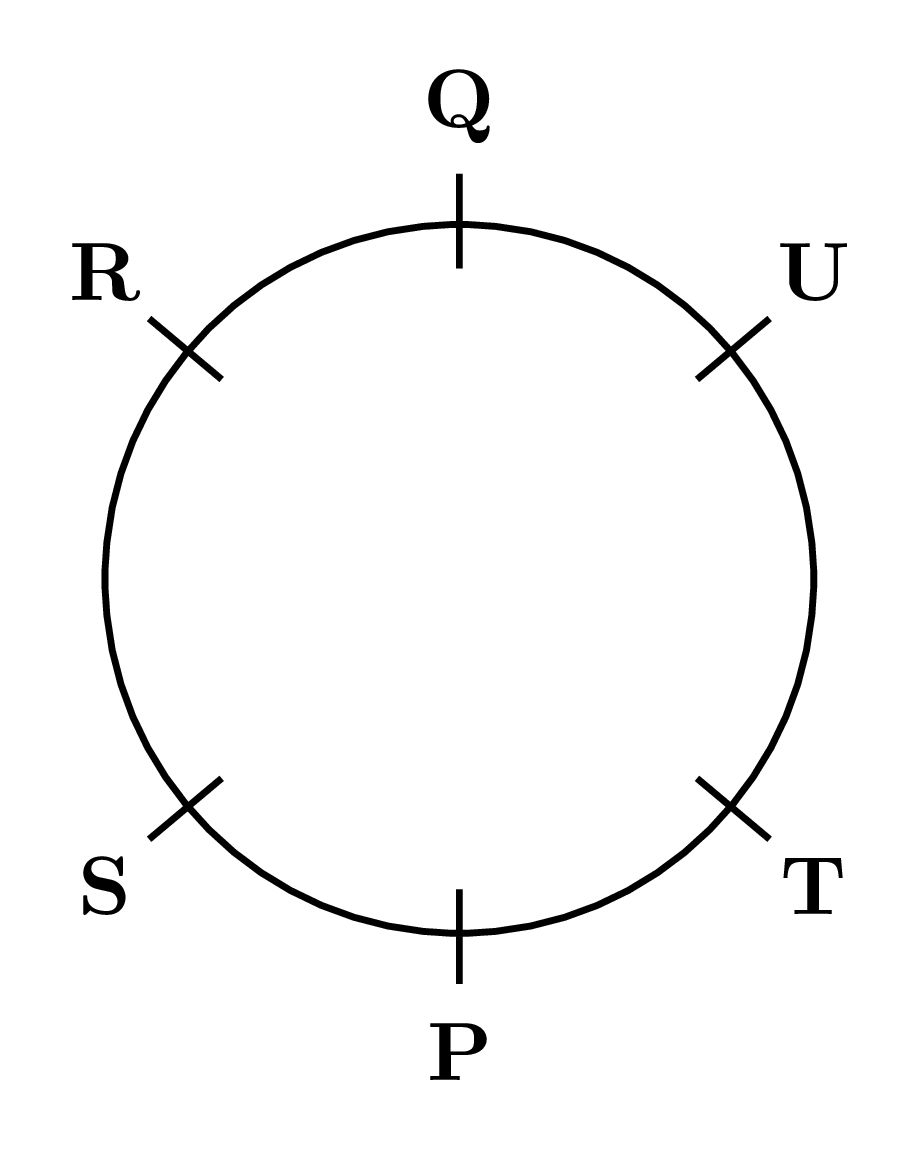
Based on the above two diagrams, $\text{Q}$ is a neighbor of $\text{R and U}.$

Correct Answer $:\text{C}$

• edited by
0 0 votes


Let us arrange the 6 seats as positions 1–6.

Since Q is diametrically opposite P, place:

  • P = 1
  • Q = 4

Since P sits next to S and T, S and T must occupy the two seats adjacent to P:

  • S, T = 2 and 6

The remaining seats 3 and 5 are for R and U.

The condition
shortest distance(S,R) = shortest distance(T,U)
forces R and U to occupy 3 and 5 respectively (in either matching arrangement).

So the arrangement is essentially:

P – S – R – Q – U – T

Therefore, the two people sitting next to Q are:

R and U

Answer: C. R and U

Answer:
Position:
Show: